 702-800-0506
 Email us
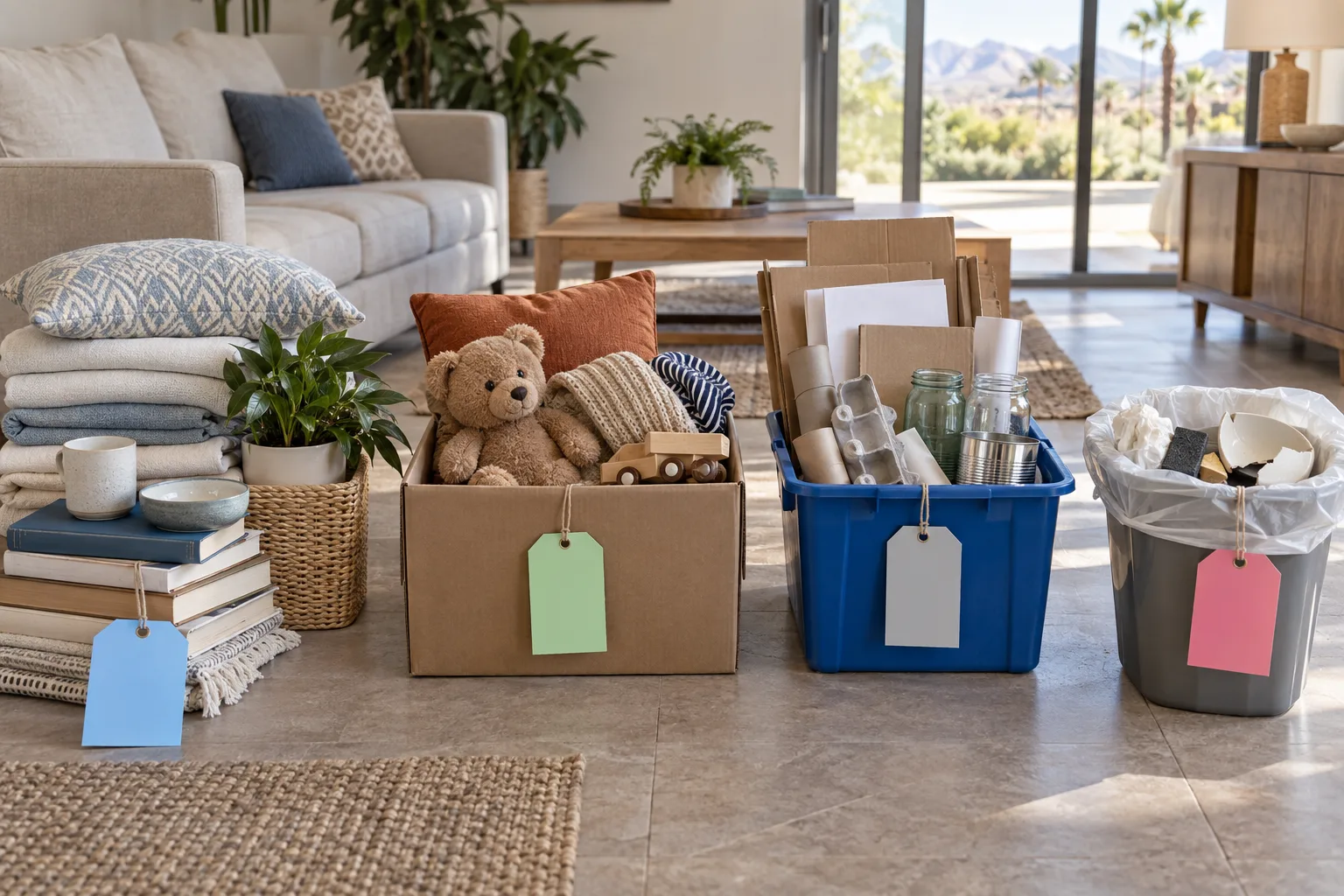
Use one question at a time. First ask whether the item must stay with the estate or family. If not, ask whether a real recipient will accept it. Recycling and disposal come after those two decisions.
The four-path rule
| Path | Use it when | Avoid this mistake |
|---|---|---|
| Keep | The item has legal, financial, personal, or confirmed family value. | Keeping every uncertain object without a review date. |
| Donate | A specific organization accepts the type and condition now. | Assuming “usable” means accepted. |
| Recycle | A local program accepts the material or device. | Putting batteries or electronics in curbside recycling without checking. |
| Dispose | The item has no viable reuse or recycling route and is legal for ordinary disposal. | Mixing hazardous material into the load. |
Make “keep” a controlled category
Start with documents and personal property that could be difficult or impossible to replace: identification, deeds, wills, financial records, tax files, insurance papers, keys, photographs, military records, jewelry, and active medication.
For ordinary household objects, give the keep pile a destination. “Going to Maria’s home” is a decision. “Someone might want this later” is a delay. Put an owner’s name and pickup date on each retained group.
Donation needs a confirmed recipient
Donation organizations screen for condition, safety, age, demand, and available space. Upholstery with stains, tears, odors, pests, or pet damage may be refused. Older appliances may be excluded even if they still run. Furniture that cannot be moved safely may also be declined.
Call or check the receiving organization’s current list before building a large donation zone. Ask about pickup, drop-off, stairs, disassembly, and whether acceptance is final only after inspection.
Match recycling to the material
Cardboard, scrap metal, electronics, batteries, and appliances do not all follow the same route. Paradise is in unincorporated Clark County, and local programs can change by material and operator. Nevada’s environmental agency maintains recycling links for Clark County and points residents to local electronics and household-hazardous-waste options.
Keep batteries out of mixed boxes. The U.S. EPA warns that lithium-ion batteries can be damaged or crushed in trash and recycling equipment, creating a fire risk. Use a dedicated, nonconductive container and confirm the receiving program’s instructions.
Dispose only after checking restrictions
Ordinary broken furniture and general household refuse may be disposal candidates. Paint, fuel, solvents, pesticides, pool chemicals, ammunition, sharps, medication, and unknown liquids are not ordinary candidates. Keep them in their original labeled containers when possible and do not combine them.
A 20-minute triage for overwhelmed rooms
- Carry out visible documents, photos, medication, keys, and small valuables.
- Mark large pieces already claimed by a person.
- Group obvious recyclable material without dismantling devices.
- Isolate leaks, powders, chemicals, batteries, and sharp objects.
- Leave the remaining volume in place for the cleanout assessment.
This method is not a substitute for a family review. It is a way to stop high-risk or high-value items from disappearing into a general pile while the larger project moves forward.
Questions to ask a donation or recycling outlet
- Do you accept this exact item and condition?
- Do you require photos before pickup?
- Are there age, size, or disassembly limits?
- Is pickup available in Paradise?
- Can the driver refuse the item after seeing it?
- What should happen if it is not accepted?
Sources checked September 17, 2026: Nevada Division of Environmental Protection recycling directory, including Clark County options; U.S. EPA guidance on used lithium-ion batteries.
Turn the sorted scope into a quote
Once the keep and review zones are protected, call 702-800-0506 for an on-site assessment of the approved removal areas.